
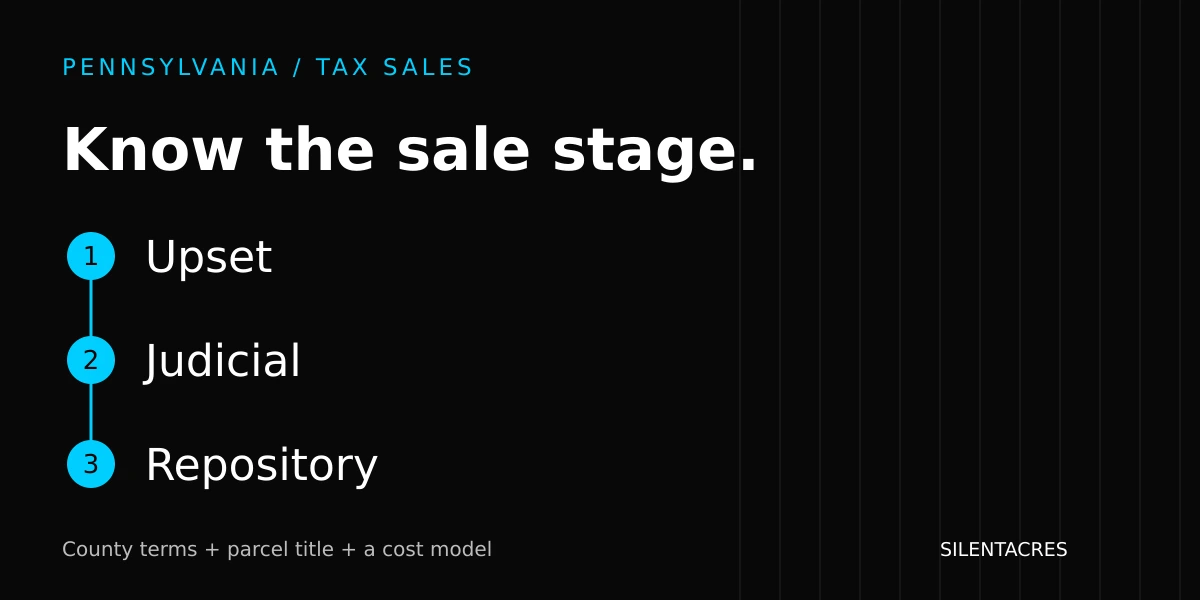
Two Pennsylvania tax-sale parcels can carry the same opening bid and leave their buyers with entirely different legal and financial problems. The sale stage matters. So do the county’s terms and the notice given to interested parties.
Before researching a parcel, identify whether it is headed to an upset sale, judicial sale, or repository offer. Then read that county’s current documents rather than relying on a statewide checklist.
THE SHORT ANSWER
How do Pennsylvania tax-sale stages differ?
Upset, judicial and repository sales involve different claim, notice and approval questions. In the Butler County example, upset buyers must investigate existing claims; judicial sales depend on proper notice; repository bids require taxing-district approval. The specific county documents and parcel title determine the result.
YOUR RESEARCH PATH
Pennsylvania tax-sale research
- Upset: investigate existing claims
- Judicial: examine notice and title
- Repository: verify required approvals
- Every stage: read county terms
Start with the county’s sale calendar and terms
County tax claim bureau pages are the best starting point for registration rules, payment deadlines, sale stage, and current parcel lists. Save the terms with your research file. A third-party auction list may help discovery, but the county controls the official process.
Butler County provides a clear comparison in its Tax Claim Bureau guidance. It describes three stages:
| Stage | How Butler County describes it | Buyer’s first concern |
|---|---|---|
| Upset sale | Initial auction for qualifying delinquent properties | Existing taxes, liens, mortgages, and other encumbrances |
| Judicial sale | Later sale after a property remains unsold | Whether required parties were properly notified and what “free and clear” covers here |
| Repository | Offer process for unsold property, with taxing-district approval | Approval steps, current terms, physical condition, and remaining legal issues |
This table is a research guide, not a universal legal rule for every county. Read the specific notice and have a Pennsylvania attorney review title questions.
Upset sale: discount the unresolved claims
At an upset sale, do not assume the winning bid gives you an unencumbered parcel. Butler County says bidders are responsible for past-due taxes, liens, mortgages, and related claims. Its wording alone is enough to put a title search ahead of any renovation or resale budget.
Susquehanna County’s posted upset-sale guidance offers another useful warning. The bureau disclaims an unencumbered title, makes no survey representation, cites the Real Estate Tax Sale Law, and identifies purchaser costs including recording and realty transfer taxes.
The posted page mixes dates from different sale years. Confirm dates and charges directly with the bureau before using it for a bid.
For each target parcel, build a claim schedule:
- Delinquent and current real estate taxes.
- Mortgages and judgment liens located in the record.
- Municipal, water, sewer, or other utility claims.
- Easements, restrictive covenants, and mineral or timber reservations.
- Estate, divorce, bankruptcy, or pending litigation issues found in the search.
- Estimated legal cost to resolve uncertainty.
Do not subtract only the opening bid from your resale estimate. Subtract the claims and work you would actually assume. Reconcile the county’s payment breakdown so taxes or charges already included in the bid are not counted twice.
Judicial sale: verify what the court process resolved
A judicial sale can offer a cleaner starting point than an upset sale, but “free and clear” should not become a substitute for reading the petition, notice record, court documents, deed terms, and county conditions.
Butler County says its judicial-sale property is sold free and clear as long as all parties are properly notified. That condition is central. Ask your attorney whether notice was proper and which interests, if any, could survive. Ask whether title insurance is available for the parcel and what exceptions the insurer proposes.
The later sale stage also tells you something about market interest. The property did not find a buyer at an earlier stage. That may reflect an inflated earlier price, legal uncertainty, poor access, physical problems, or simple lack of attention. Find the reason before treating the discount as found money.
Repository: price delay and approval risk
Repository property has remained unsold through earlier stages. Butler County describes a written bid process followed by presentation of the highest bid to three taxing districts for approval. This is different from raising your hand and receiving immediate auction confirmation.
Check whether the property remains available, who must approve the offer, when payment is due, and whether your offer can be withdrawn while approval is pending. Put any holding-period delay into your plan. Avoid spending on improvements before title has transferred and you have lawful possession.
A low repository offer can be rational when you understand why earlier buyers passed. It is weak when the only supporting fact is that the county wants the parcel back on the tax rolls.
Research the land as though there were no discount
Once the legal stage is clear, investigate the parcel on its own merits.
Confirm the tax map number and deed description. Trace legal access from a public road. Review current zoning and subdivision requirements. Inspect from lawful vantage points. Screen soils through USDA Web Soil Survey and flood products through FEMA’s Map Service Center.
For mineral claims, review the actual chain of title and recorded leases. Pennsylvania DEP’s oil and gas mapping tool can show nearby conventional and unconventional wells, but a nearby well does not prove that your parcel owns minerals, sits in a unit, or will generate royalties.
If inspection is restricted, write down what remains unknown and reserve for it. Never enter a structure or cross private land because it appears on a sale list.
Compare two bids on the same hypothetical parcel
Assume conservative resale value of $55,000 and identical selling and holding costs of $12,000. Your required margin is $15,000.
Upset-sale version: You find $10,000 in claims and reserve $5,000 for legal and physical uncertainty. The maximum bid is:
$55,000 − $12,000 − $15,000 − $10,000 − $5,000 = $13,000.
Judicial-sale version: After legal review, you reduce the claims allowance to $1,000 and keep the same $5,000 uncertainty reserve. The maximum bid becomes:
$55,000 − $12,000 − $15,000 − $1,000 − $5,000 = $22,000.
The $9,000 difference comes from changed assumptions, not a better property description. If title review later adds an exception, change the bid again.
THE WORKED EXAMPLE
Same parcel, different claim costs
- Resale less costs and margin: $28,000
- Claims $10,000 + reserve $5,000
- Upset example bid cap: $13,000
- Claims $1,000 + reserve: cap $22,000
Set a walk-away packet for auction day
Carry one sheet per parcel with the sale stage, maximum bid, payment requirements, unresolved issues, and reasons to stop. Include a separate line for current taxes and fees so they cannot disappear inside a round-number bid.
If the price passes your cap, let another buyer take the risk. If you win, calendar payment, court or county approval, deed recording, insurance, and tax billing immediately. The purchase becomes manageable when the legal file and cost model are already organized before ownership arrives.
Sources & records
Read the cited record in context. Historical notices are examples; use current terms for an actual purchase.
About this guide
Published by SilentAcres. This guide explains records and decision criteria; it does not certify a parcel’s title or value. No attorney review is represented.